
Scoping Document
5. Spatial Strategy
Introduction
5.1To help deliver the vision, within this chapter we will set out the spatial strategy. This will guide mineral development to appropriate locations and be used as one of the stages in our site selection process. Further detail on this is given within the Draft Site Selection Assessment methodology which we also welcome feedback on.
5.2It should be noted that sites will not be allocated based on the spatial strategy alone. As identified in the draft site selection methodology, there will be other stages which will filter and determine which sites are most appropriate to allocate. This includes assessing site’s suitability, looking at any constraints, including impacts on the natural and historic environment, and local amenity.
5.3Any site at the planning application stage, allocated or not, would also be subject to the national decision - making policies and any relevant local policies which would ensure there are no harmful impacts. If a site therefore satisfies the spatial strategy, this does not automatically mean permission will be granted. The role of the spatial strategy is to help guide developers to locations where development may be acceptable.
5.4To understand what the spatial strategy should contain, we have considered:
- Identified potential themes for the vision
- Requirements set out in the plan-making policies in the NPPF
- The current adopted Minerals Plan spatial strategy approach
5.5From these, the Councils have then identified key points which we think the spatial strategy should include. As per policy S2, the spatial strategy will be illustrated on a key diagram once finalised.
Requirements from NPPF
5.6We have gone through the NPPF and identified the relevant plan - making policies that set out what the spatial strategy must do. These policies and their requirements are shown in Table 2.
5.7Table 2 only reflects what is relevant to the minerals plan. For example, clause 1(b) of Policy S2: Producing a spatial strategy requires the spatial strategy to identify boundaries of town centres and clause 1(d) relates to housing and associated infrastructure. These are matters for local plans in each authority and so are not relevant to the minerals plan.
Table 2: Key plan-making policies and their requirements for developing a spatial strategy
|
NPPF Policy |
Summary of policy requirements for Plans |
|
PM2: Local plans |
|
|
PM3: Minerals and waste plans |
|
|
S2: Producing a spatial strategy |
|
|
CC1: Planning for climate change |
|
|
TR1: Vision-led approach to planning for transport |
|
|
HC1: Planning for healthy communities |
|
|
P1: Planning for clean and safe places |
|
Question 6: Is there any other national plan-making policies we need to take into consideration when developing the spatial strategy? Comment
Adopted Plan Strategy
5.8Whilst the current adopted Nottinghamshire Minerals Local Plan does not have a spatial strategy, Policy SP1: Minerals Provision does provide a strategy for the supply of Minerals.
5.9The policy supporting text notes that minerals are a finite natural resource that can only be worked where they are found and prioritises the best use of minerals resource by:
- Supporting extensions to existing sites where economically, socially and environmentally acceptable
- Encouraging the use of secondary and recycled aggregates
- Safeguarding resources from sterilisation
5.10Policy SP1 then provides the strategy for the supply of minerals, which is to:
- Identify sites suitable for extraction that maintain a steady and adequate supply of minerals
- Supporting extensions to existing mineral sites, where economically, socially and environmentally acceptable
- Allow non-allocated sites to be permitted where a need can be demonstrated
- Ensure the provision of minerals remains in line with wider economic trends
5.11Encouraging the use of secondary and recycled aggregates and safeguarding is then addressed separately in Policy MP5 and Policy SP7.
Question 7 : Are there any elements of the current strategy that you think work well and should be retained? Comment
Emerging Spatial Strategy themes
5.12Considering the emerging vision, plan - making policy requirements and the current adopted Plan’s strategy for minerals, the Councils have identified key themes which we think the future spatial strategy could include. Further detail on each theme is provided below.
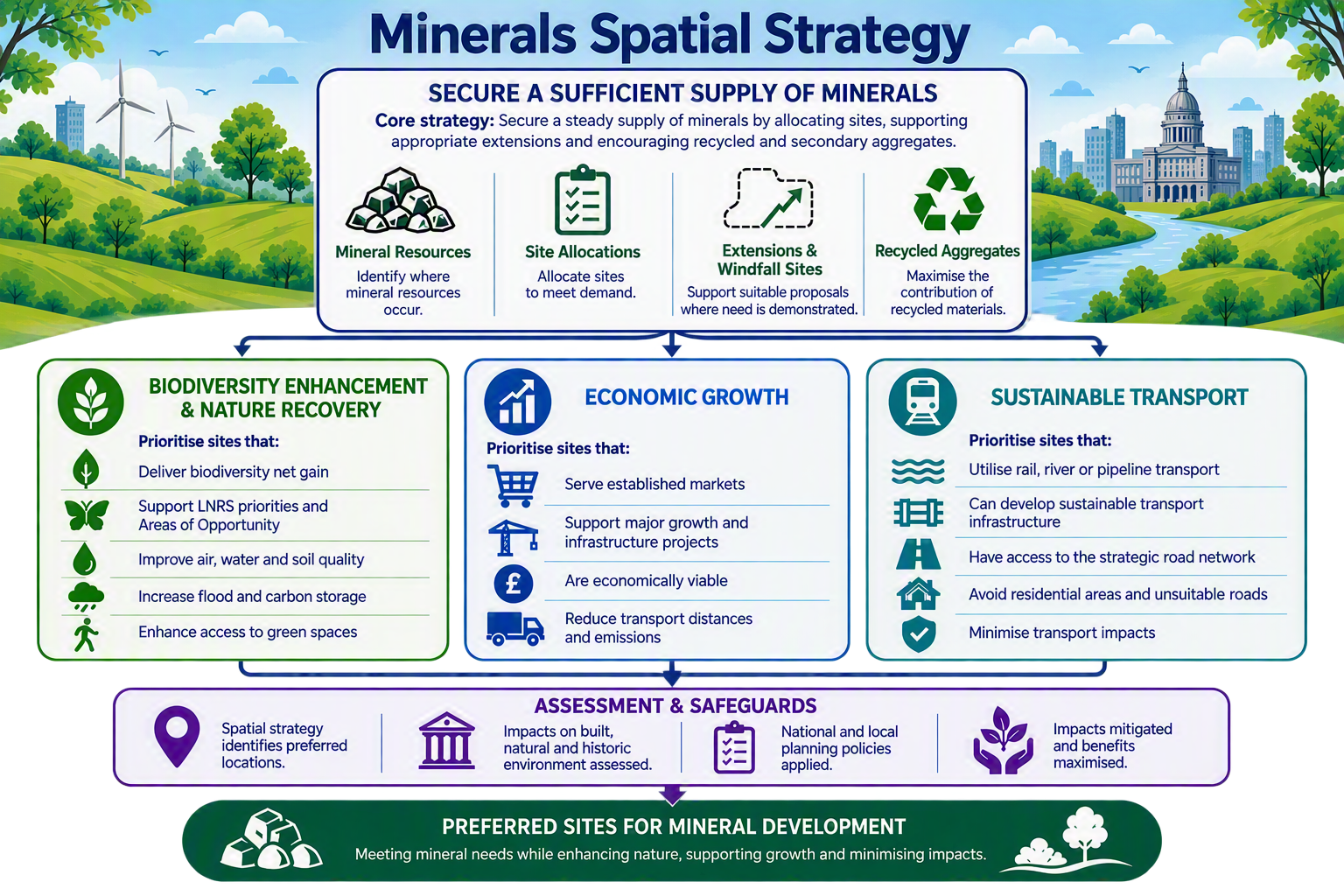
Securing a sufficient and timely supply of minerals
5.13First and foremost, the spatial strategy will need to recognise that securing a sufficient and timely supply of minerals to meet society’s demand in Nottinghamshire is the key aim of the Plan (satisfying policies PM2 and PM3).
5.14To ensure a sufficient supply, the strategy would firstly recognise that minerals can only be worked where they are found and are a finite resource. Where the mineral resource in Nottinghamshire can be found would be identified on the spatial diagram.
5.15To meet the identified demand of minerals, like Policy SP1 of the adopted Plan, the overarching strategy will be to allocate sites, supporting extensions and non-allocated sites where a need can be demonstrated and which are economically, socially and environmentally acceptable.
5.16The strategy will also continue to encourage the use of secondary and recycled aggregates, considering how they can contribute to supply.
Biodiversity enhancement and nature recovery
5.17The current adopted Plan (policy SP2) focuses on ensuring that restoration of mineral sites is biodiversity led, seeking to maximise biodiversity net gain and accord with local targets and opportunities for nature.
5.18Ensuring Plans deliver nature - based solutions, that could also help mitigate and build resilience to climate change, should be a key part of the strategy as identified in the plan - making policies of the NPPF (policies PM2, S2, CC1, HC1 and P1). Minerals offer the unique opportunity to deliver biodiversity and nature improvements through their restoration.
5.19Considering this, we consider that biodiversity enhancement and nature recovery should be included in the spatial strategy. The strategy would therefore seek sites which:
- Lead to the most improvement in biodiversity
- Deliver biodiversity priorities and areas that could become of particular importance for biodiversity (ACBs) identified within the LNRS
- Offer opportunities to improve air, water and soil pollution
- Offer opportunities for increased flood and/or carbon storage
- Offer opportunities to improve access to green spaces for physical and mental well - being
Supporting sustainable economic growth
5.20Under this theme, sites for mineral development would be guided to locations which are driven and led by the market and operators through the spatial strategy.
5.21This approach would therefore ensure demand is being met by sites which are economically viable for operators and can enable and support economic growth in Nottinghamshire (meeting policies PM2 and PM3). It could also reduce distances minerals need to be transported and so help to reduce emissions and the impact of mineral development on climate change and local communities (meeting policies CC1 and P1).
5.22If this is the key theme for the spatial strategy, sites would therefore be located where:
- Mineral operators deem need is necessary to serve established markets across Nottinghamshire. Recognising that for some minerals, such as gypsum and silica sand, the market will be beyond the Plan area.
- New growth and major infrastructure projects are located
Sustainable movement of minerals
5.23Policy SP4 of the current adopted minerals plan seeks to maximise sustainable transport, with Policy TR1: Vision-led approach to planning for transport also requiring plans to consider sustainable transport at the earliest stages.
5.24For minerals, sustainable transport would be the use of road alternative transport, such as barge, rail or pipelines throughout the life of the site. This would help minerals reduce their carbon emissions but also reduce the impact on local road networks and residents (meeting policies CC1 and P1).
5.25It is though acknowledged that such methods of transport are not always practical or economical. Therefore, the spatial strategy would also need to acknowledge that road transport is likely to still occur and seek to minimise the impact of this.
5.26Under this theme of sustainable transport, the spatial strategy would locate development to sites that:
- Are near existing river or rail infrastructure that could transport minerals
- Could develop barge, rail or pipeline infrastructure
- Are near the main highway network and existing transport routes
- Avoid residential areas and minor roads
- Minimise impacts on the road network
Developing the spatial strategy
5.27Whilst the first theme of securing a sufficient supply of minerals to meet need sets out the overarching strategy, the other themes would help drive mineral development to certain locations. We would appreciate your views on which theme would be the most appropriate to take forward, or whether there are any others we should consider.
5.28We anticipate that the spatial strategy may include all the above themes, with any others identified as appropriate, but with one taking a leading role to help select which sites should be allocated for mineral development.
5.29Again, it should be noted that a site will not be allocated or permitted based upon the spatial strategy alone. Consideration of impacts, for example on the historic environment, landscape and residential amenity will be assessed in the site selection methodology for allocated sites. All sites would also be assessed against the national decision - making policies and relevant local policies at the planning application stage to ensure any impacts are adequately mitigated.
Question 8: Do you agree with the themes proposed for the spatial strategy? Is there anything that we have missed and should be included? Comment
Question 9: Which theme out of biodiversity and nature, market led and sustainable transport, do you think should be the leading anchor for the spatial strategy? Comment


